
-

Watch HOPE Summit 2026 Videos
HOPE Summit 2026 was filled with old friends reuniting, new friends being made, and of course, plenty of inspirational and informative sessions designed to help people live well with lung cancer.
For...
IN THE SPOTLIGHT
-
Clinical Trial Access Isn’t Expanding. It’s Concentrating.
Clinical trials show us whether a new treatment is safe and effective. They are also an important way for patients to access cutting-edge care. For trials to truly serve the lung... -

Podcast: Lung Cancer Diagnosis—What Happens Next
What happens after a lung cancer diagnosis? In this first episode of LUNGevity’s Lung Cancer Voices of Hope podcast, lung cancer survivor Lisa Bistline shares her experience, from... -
Podcast: Why Community Matters in Lung Cancer Care
Why does finding community matter in lung cancer care? In this episode, lung cancer survivor and advocate Jill Feldman shares her experience, from losing multiple family members to... -
LUNGevity Foundation Invests $1.2 Million to Fuel Next Generation of Lung Cancer Research
LUNGevity Foundation announced $1.2 million in research awards that are designed to strengthen the lung cancer workforce and accelerate progress across the lung cancer continuum... -

Scalp Care, Shaving, and Head Coverings: Comfort Through Hair Loss
This video is a recording from a LUNGevity virtual meetup. Each month, we host multiple virtual meetups for those impacted by lung cancer to meet and connect with others who... -
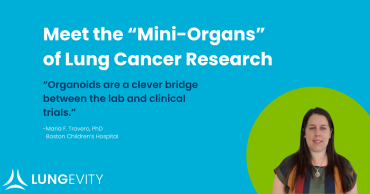
Meet The “Mini-Organs” of Lung Cancer Research
Though many of us would like to deny it, our neighbors affect us. Their loud music disturbs our sleep. The scent of their dinner wafts through an open window. The sight of their... -
Three Moments That Defined the 2026 Targeted Therapies of Lung Cancer Conference
The 2026 Targeted Therapies of Lung Cancer Meeting brought together leading clinicians, researchers, and patient advocates to discuss the latest advances shaping the future of lung... -

EGFR Virtual Meetup
EGFR patients/survivors - Join us the 1st Wednesday of every month to connect with others who share common experiences and build your community. -
Progress in Cancer Care: What the Numbers Tell Us About Lung Cancer
Every January, the American Cancer Society releases a Cancer Facts & Figures report. It provides a clear view of where we stand in addressing cancer. The 2026 report brings both...
Optimal treatment strategies for unresectable stage III EGFR-mutated non-small cell lung cancer: a systematic review and Bayesian network meta-analysis
Optimal treatment strategies for unresectable stage III EGFR-mutated non-small cell lung cancer: a systematic review and Bayesian network meta-analysis
Survival outcomes and a prognostic nomogram in EGFR-mutant non-small cell lung cancer with leptomeningeal metastasis: a real-world cohort study
Survival outcomes and a prognostic nomogram in EGFR-mutant non-small cell lung cancer with leptomeningeal metastasis: a real-world cohort study
Clinical Outcomes of Second-Line FOLFIRI Plus Ramucirumab According to Prior Biologic Exposure in Metastatic Colorectal Cancer: A Retrospective Comparison of Prior Bevacizumab and Prior Anti-EGFR Cohorts
Clinical Outcomes of Second-Line FOLFIRI Plus Ramucirumab According to Prior Biologic Exposure in Metastatic Colorectal Cancer: A Retrospective Comparison of Prior Bevacizumab and Prior Anti-EGFR Cohorts
Habitat model based on CEUS for noninvasive prediction of EGFR mutation status in peripheral NSCLC
Habitat model based on CEUS for noninvasive prediction of EGFR mutation status in peripheral NSCLC
Racura Oncology Doses First Patient in Phase 1 HARNESS-1 Trial of RC220 in EGFR-Mutant Non-Small Cell Lung Cancer
Racura Oncology Doses First Patient in Phase 1 HARNESS-1 Trial of RC220 in EGFR-Mutant Non-Small Cell Lung Cancer
Racura Oncology Doses First Patient in Phase 1 HARNESS-1 Trial of RC220 in EGFR-Mutant Non-Small Cell Lung Cancer
Racura Oncology Doses First Patient in Phase 1 HARNESS-1 Trial of RC220 in EGFR-Mutant Non-Small Cell Lung Cancer
Racura Oncology Doses First Patient in Phase 1 HARNESS-1 Trial of RC220 in EGFR-Mutant Non-Small Cell Lun
Racura Oncology Doses First Patient in Phase 1 HARNESS-1 Trial of RC220 in EGFR-Mutant Non-Small Cell Lun
Body mass index and fasting insulin predict survival and EGFR–TKI benefit in Stage IV lung adenocarcinoma
Body mass index and fasting insulin predict survival and EGFR–TKI benefit in Stage IV lung adenocarcinoma
Cryptotanshinone Targets Ferroptosis in Glioma via the EGFR/ROS Signaling Pathway
GPNMB regulates EGFR mitochondrial translocation via HK2, influencing microglial respiratory chain and metabolic defects to promote polarization and stroke progression
GPNMB regulates EGFR mitochondrial translocation via HK2, influencing microglial respiratory chain and metabolic defects to promote polarization and stroke progression
Podcast: What are Biomarkers and Why Should You Get Tested?
Podcast: What are Biomarkers and Why Should You Get Tested?
What are biomarkers, why do they matter, and what should every person living with lung cancer know about getting tested? Dr. Ross Camidge, a world-renowned thoracic oncologist and lung cancer researcher at the University of Colorado, joins Ann Steagall and Dr. Misty Shields to explain the ins and outs of biomarkers. Dr. Camidge helped pioneer biomarker testing as a standard of care, but he also brings the patient perspective as well - he was diagnosed with EGFR-mutant non-small cell lung…
Neuropathy and Lung Cancer: What Patients Need to Know
Neuropathy and Lung Cancer: What Patients Need to Know
LUNGevity offers a variety of virtual support groups called ‘meetups’ where survivors and caregivers impacted by lung cancer connect with others who understand the patient experience. Once a month, we invite an expert to share information on a topic related to life with lung cancer, engage with attendees, and answer questions in real time. In May, we welcomed Aileen Anglin, ACNP-BC, AOCNP, from MD Anderson Cancer Center, to talk about peripheral neuropathy. Peripheral neuropathy…
Precision, Partnership, Purpose: Lung Cancer Highlights from AACR 2026
Precision, Partnership, Purpose: Lung Cancer Highlights from AACR 2026
The American Association for Cancer Research (AACR) Annual Meeting brought together thousands of cancer researchers, clinicians, advocates, and patients in San Diego from April 17–22. This year's theme—“Precision, Partnership, Purpose: Advancing Cancer Science to Save Lives Globally”—set a powerful tone for a meeting that showcased advances across the lung cancer landscape. One message was loud and clear. Science is accelerating, and we are reimagining how healthcare is delivered. From…
Podcast: Making the Most of Your Healthcare Visits
Podcast: Making the Most of Your Healthcare Visits
How do you make the most of your visits with your healthcare team? In this episode, lung cancer survivor Bill Morris shares his experience with lung cancer and how he approaches his healthcare visits now. Oncology nurse practitioner Rasheda Persinger shares her insights after 20 years of working with patients. Hosts Ann and Dr. Shields discuss with Bill and Rasheda what they wish every patient knew, from writing down questions before an appointment to asking about biomarker testing to why…
Watch HOPE Summit 2026 Videos
Watch HOPE Summit 2026 Videos
HOPE Summit 2026 was filled with old friends reuniting, new friends being made, and of course, plenty of inspirational and informative sessions designed to help people live well with lung cancer.For the second year in a row, select sessions were recorded so those who could not attend are still able to access the valuable information shared.HOPE Summit 2026 Recorded Sessions Keynote: Wagons Roll with Dr. Ross Camidge Back in the Saddle: Reclaiming Strength and Living Well …
Clinical Trial Access Isn’t Expanding. It’s Concentrating.
Clinical Trial Access Isn’t Expanding. It’s Concentrating.
Clinical trials show us whether a new treatment is safe and effective. They are also an important way for patients to access cutting-edge care. For trials to truly serve the lung cancer community, the people who enroll in the trials need to represent the populations who are diagnosed in everyday life.Recognizing these needs, federal agencies like the United States Food and Drug Administration (FDA) have been encouraging clinical trials to offer more locations across the US.The PlanThe intention…
Podcast: Why Community Matters in Lung Cancer Care
Podcast: Why Community Matters in Lung Cancer Care
Why does finding community matter in lung cancer care? In this episode, lung cancer survivor and advocate Jill Feldman shares her experience, from losing multiple family members to lung cancer to her own diagnosis, as well as her work building patient communities around the world. She discusses how connecting with others has shaped her journey and why community is important for support, information, and advocacy.Hosts Ann Steagall, RN, BSN, and Misty Shields, MD, PhD, explore with Jill how…
Podcast: Lung Cancer Diagnosis—What Happens Next
Podcast: Lung Cancer Diagnosis—What Happens Next
What happens after a lung cancer diagnosis? In this first episode of LUNGevity’s Lung Cancer Voices of Hope podcast, lung cancer survivor Lisa Bistline shares her experience, from initial scans and biopsies through multiple treatments, and the moment a later biopsy revealed a biomarker that led to a targeted therapy.Hosts Ann Steagall and Misty Shields, MD, PhD, then speak with Anne Chiang, MD, PhD, thoracic oncologist at Yale University, about what patients can expect at their first visit,…
Scalp Care, Shaving, and Head Coverings: Comfort Through Hair Loss
Scalp Care, Shaving, and Head Coverings: Comfort Through Hair Loss
This video is a recording from a LUNGevity virtual meetup. Each month, we host multiple virtual meetups for those impacted by lung cancer to meet and connect with others who understand them and what they’re going through.Periodically, we invite an expert to speak on a topic at the beginning of a meetup, with the second half dedicated to questions and conversation. Visit the online calendar to see our virtual meetups and other upcoming events.For this meetup, we welcomed Jenna Doyle Ruhl and…
Meet The “Mini-Organs” of Lung Cancer Research
Meet The “Mini-Organs” of Lung Cancer Research
Though many of us would like to deny it, our neighbors affect us. Their loud music disturbs our sleep. The scent of their dinner wafts through an open window. The sight of their new puppy brings a smile. We interact with our environment every moment of the day. And so do lung cancer cells. A Brief HistoryTraditionally, we have studied tumor cells in isolation. We often study single cells in a petri dish, or under a microscope, to understand how they work. This has been very important and…
Three Moments That Defined the 2026 Targeted Therapies of Lung Cancer Conference
Three Moments That Defined the 2026 Targeted Therapies of Lung Cancer Conference
The 2026 Targeted Therapies of Lung Cancer Meeting brought together leading clinicians, researchers, and patient advocates to discuss the latest advances shaping the future of lung cancer care. Hosted by the International Association for the Study of Lung Cancer, this annual gathering was held in Huntington Beach, California from Feb. 18-21, 2026. It has become known as one of the key meetings for participants to discuss the latest breakthroughs and challenges in lung cancer.This year’s meeting…
Progress in Cancer Care: What the Numbers Tell Us About Lung Cancer
Progress in Cancer Care: What the Numbers Tell Us About Lung Cancer
Every January, the American Cancer Society releases a Cancer Facts & Figures report. It provides a clear view of where we stand in addressing cancer. The 2026 report brings both encouraging news and a sobering reminder that our work is far from over.The Big Picture Shows Real ProgressLet’s start with the good news. We have made significant strides in cancer care over the past three decades. Since 1991, the cancer death rate has dropped by 34%. This translates to approximately 4.8 million…
Artificial Intelligence in Lung Cancer: Hope vs. Hype
Artificial Intelligence in Lung Cancer: Hope vs. Hype
Artificial intelligence (AI) is rapidly reshaping the future of cancer care, but such dramatic innovation also brings important questions.AI has evolved from early consumer tools (like autocorrect on phones, customer service chatbots, and personalized shopping recommendations) to advanced systems with the potential to revolutionize biomedical discovery and patient care. While there is tremendous excitement around AI, there is also a critical need to use it responsibly.Researchers are actively…
The Future of Lung Cancer Starts Here
The Future of Lung Cancer Starts Here
For more than two decades, LUNGevity Foundation has been a leader in advancing lung cancer research. Since 2002, we have invested $55+ million in more than 200 research projects, helping to build a robust pipeline of discoveries in early detection, treatment innovation, and health equity.Once again, LUNGevity is ready to open our annual grant cycle in 2026 with five research programs designed to address the most pressing challenges in lung cancer care. In addition, these grants ensure the…
Biggest News from Berlin: Research Highlights from ESMO
Biggest News from Berlin: Research Highlights from ESMO
Lung cancer research was in the spotlight at the European Society for Medical Oncology (ESMO) meeting held October 17-21, 2025, in Berlin, Germany. With approximately 30,000 attendees from over 100 countries, this meeting gathered an international audience of clinicians, researchers, patient advocates, and representatives from the healthcare industry to discuss cutting-edge cancer research and share practice-changing clinical trial data. We saw data from studies that aim to build upon…
LUNGevity Foundation Invests $1.2 Million to Fuel Next Generation of Lung Cancer Research
LUNGevity Foundation Invests $1.2 Million to Fuel Next Generation of Lung Cancer Research
LUNGevity Foundation announced $1.2 million in research awards that are designed to strengthen the lung cancer workforce and accelerate progress across the lung cancer continuum—from early detection to treating advanced disease.“Today’s research is tomorrow’s cure. If we want to see continued breakthroughs and advancements in lung cancer, we must secure a strong pipeline of researchers dedicated to improving outcomes for people with lung cancer,” said Upal Basu Roy, PhD, MPH, Executive Director…
Celebrating Progress in Lung Cancer: From Detection to Survivorship
Celebrating Progress in Lung Cancer: From Detection to Survivorship
Over the past twenty years, lung cancer research and care have entered a new era. One filled with hope, innovation, and progress that is transforming what it means to face a lung cancer diagnosis. From groundbreaking early detection efforts to life-extending treatments, each step forward represents years of collaboration between researchers, patients, and others in the lung cancer community.Today, LUNGevity celebrates five exciting areas of progress that highlight the incredible strides made…
Veteran Voices: Surgery to Survivorship at the VA
Veteran Voices: Surgery to Survivorship at the VA
Last November, Michael O’Donnell was at the Dallas VA during Lung Cancer Awareness Month. It’s where he receives treatment for his lung cancer, but on this specific day, he was joined by LUNGevity staff to talk with veterans about screening.“My job was easy. I was at a table with Kristi Griffith [LUNGevity’s Survivorship Navigator] so that I could answer questions as someone who uses the VA to get treated for lung cancer,” says Michael. Michael is a veteran of the Vietnam War and uses the…
Aiming for a Cure: How CD74 Research Could Eliminate Drug-Resistant Lung Cancer for Good
Aiming for a Cure: How CD74 Research Could Eliminate Drug-Resistant Lung Cancer for Good
Lung cancer remains the leading cause of cancer death worldwide. Over the past two decades, the development of targeted therapies, particularly tyrosine kinase inhibitors (TKIs), has brought real hope to people with EGFR-positive lung cancer—a lung cancer subtype driven by specific mutations in the EGFR gene. These drugs can shrink tumors dramatically, sometimes so much that they seem to disappear on scans. But beneath these promising results lies a stubborn problem: a small number of cancer…
New Insights in Treating Metastatic Lung Cancer from WCLC 2025
New Insights in Treating Metastatic Lung Cancer from WCLC 2025
For people with advanced or metastatic non-small cell lung cancer (NSCLC), the treatment landscape has changed dramatically in recent years. Researchers are learning how to optimize existing therapies and are exploring entirely new treatment approaches. At the 2025 World Conference on Lung Cancer (WCLC), several studies highlighted progress in treating newly diagnosed individuals as well as those who need new options after standard therapies stop working. Combining Chemotherapy and…