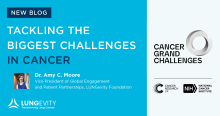
Tackling the Biggest Challenges in Cancer

Cancer Grand Challenges is a partnership between Cancer Research UK (CRUK) and the National Cancer Institute (NCI), which funds global teams of leading researchers across various scientific disciplines to tackle some of the toughest challenges in cancer research. As Dinah Singer, Acting Director of NCI’s Center for Strategic Scientific Initiatives says, “Cancer research is a global endeavor.” As LUNGevity’s Vice President of Global Engagement and Patient Partnerships, I recently attended the Cancer Grand Challenges (CGC) Summit March 8-10, 2023 in London. The CGC Summit featured an action

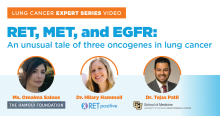
RET, MET, and EGFR: An unusual tale of three oncogenes in lung cancer

LUNGevity's Upal Basu Roy, PhD, MPH, Executive Director, Research, discusses innovative research into RET+ NSCLC with patient advocates and the scientist conducting the studies. Panelists include Omaima Salous (diagnosed with RET+ NSCLC and co-founder of The Hamoui Foundation), Dr. Hilary Hammell (diagnosed with RET+ NSCLC and co-chair of RETpositive), and Dr. Tejas Patil (Assistant Professor, University of Colorado). The discussion focuses on Dr. Patil’s RET+ NSCLC research project and why it matters to patients. This project is supported by a Hamoui Foundation/LUNGevity Foundation award for

Real-World Drug Development at the Targeted Therapies of Lung Cancer Meeting

The development of new treatments for any disease relies on the collaborative efforts of many different stakeholders, such as scientists, clinicians, patient advocacy groups, regulators, and pharmaceutical and biotech companies. During scientific conferences that happen throughout the year, stakeholders cobble together opportunities to discuss the current state of treatments and strategize ways to bring emerging lifesaving treatments to patients. Each year, there is one key conference dedicated to bringing these stakeholders together with the sole goal of discussing the development of

Researchers Make New Inroads for EGFR Exon20+ NSCLC Patients

While our bodies can have a wide range of naturally occurring, harmless mutations in different genes, some mutations, called driver mutations, are key to driving the development of cancer. There are many driver mutations. Researchers have been developing drugs that target specific driver mutations in lung cancer, creating therapies for those patients whose lung cancer harbors them. Early Targeting of EGFR In the early 2000s, EGFR was the first gene in non-small cell lung cancer (NSCLC) to be matched with a targeted therapy. Originally, researchers focused on the two driver mutations in the

Targeted Therapy Options for Patients with EGFR Exon20+ NSCLC

Researchers have made tremendous progress in treating lung cancer by identifying key mutations in genes that drive the growth of lung cancer. Once these “driver” mutations are identified, researchers can work to target these mutations with specific treatments, called targeted therapies. FDA-approved targeted therapies exist for treating EGFR-positive NSCLC, or non-small cell lung cancer (NSCLC) patients whose tumors test positive for exon19 and exon21 L858R mutations in the EGFR (epidermal growth factor receptor) gene. But there are patients with NSCLC whose tumors have other EGFR mutations

Science Spotlight: NSCLC Transformation into SCLC

Take a behind-the-scenes look at how researchers study lung cancer. Join lung cancer researcher Triparna Sen, PhD, as she digs into what’s known about how EGFR-positive NSCLC cells transform into SCLC to escape targeted therapy treatment. SCLC transformation is a common resistance mechanism for multiple types of NSCLC, including EGFR, ALK, and RET. This Facebook Live event is hosted by Amy Moore, PhD, LUNGevity’s Vice President of Global Engagements and Patient Partnerships. Dr. Sen is Co-Director of the Lung Cancer PDX Platform at the Center for Thoracic Oncology, Icahn School of Medicine at

We're Live-Tweeting from ASCO June 3-7!

LUNGevity’s Dr. Upal Basu Roy and Dr. Amy Moore will be live-tweeting from the American Society of Clinical Oncology (ASCO) annual meeting. Follow LUNGevity on Twitter and the hashtags #ASCO22 and #LCSM to be a part of the action. Times and topics of live-tweeted sessions are as follows: Fri, Jun 3, 2022 | 2:00 PM – 5:00 PM EDT | Lung Cancer—Non-Small Cell Metastatic Sun, Jun 5, 2022 | 9:00 AM – 10:15 AM EDT | Treatment Sequencing in Resectable Lung Cancer: The Good and the Bad of Adjuvant Versus Neoadjuvant Therapy Sun, Jun 5, 2022 | 10:45 AM – 1:45 PM EDT | Lung Cancer—Non-Small Cell Local

Lung Cancer Treatment Landscape: New Options and Ongoing Challenges

Drs. Upal Basu Roy, Amy Moore, and Dhru Deb discuss their recent publication in which they presented an analysis of the lung cancer drug pipeline. They talk about what it means for patients, new drugs under development for NSCLC and SCLC, and some of the ongoing challenges and opportunities this rapid growth means for the lung cancer community.

New Options in Adjuvant Therapy for Early-Stage NSCLC

Historically, surgery has been the most effective treatment for patients with early-stage non-small cell lung cancer (NSCLC). While technological improvements, such as the development of minimally invasive techniques (such as video-assisted thoracoscopic surgery or VATS), have made surgeries safer for patients, the ability to cure early-stage NSCLC patients hasn’t improved significantly in recent decades. Even after successful surgeries that completely remove the visible tumor, about half of these patients will face a recurrence with their cancer coming back within five years. Researchers have

Studying Drug Resistance From a New Angle

The development of “targeted therapies” which block the function of mutant proteins within tumor cells has revolutionized the treatment landscape for many cancers, most of all lung cancer. EGFR is one such protein which is often altered (mutated) in lung cancers. Over the past decade, multiple EGFR targeted therapies have been developed, with each generation of drugs becoming increasingly potent. At present, patients with advanced EGFR-mutated lung cancer are treated with osimertinib (Tagrisso®), the latest and most effective FDA-approved EGFR targeted therapy to date. Unfortunately, despite